Sunday, October 28, 2012

Mayan Deities

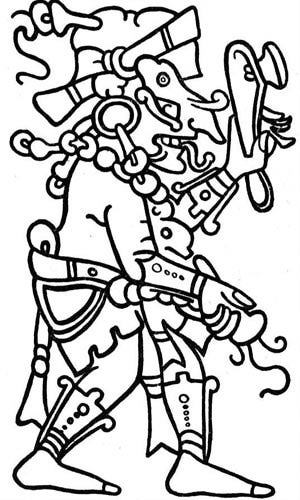
This week's topic was the Mayan religion and their gods. I really enjoyed learning about their gods and how their view of them is rather different from how most people view god today. The Maya sometimes would see one god as many gods and one god could actually be the exact same god as another. That part makes the Mayan deities rather confusing. However, by analyzing key gods and learning which ones are commonly divided, the gods become easier to comprehend. One god that is commonly multiple gods is Chaak. Another one that is interesting is K'uk'uclan, the Plumed Serpent. K'uk'uclan is the same as the Aztec god Quetzalcoatl, which is to me, a bit odd. It's just strange that the Maya used a god from a different religion and made it their own. All in all, the Mayan religion is very interesting.

Dance

Wednesday's FYS class was unique in that we sat in on a dance lecture. I learned about the various types of dances and about how some dances center on the music while others focus on the movements. I also learned about leading and following. The seminar also made it very clear that dancing is about communication, whether it is with the partner or to the audience. The one question I was left with was about tribal dances. All sorts of ballroom and social dances were discussed but since our FYS class is about the Maya, I wondered what their dances were like or how they viewed dance, if they danced at all.

Monday, October 22, 2012

Mayan Goddess: Ixchel

The Maya had many gods and goddesses. I found one I haven't heard of before named Ixchel. Ixchel is the mayan goddess of child birth, medicine, crafts, rainbows, and the moon. She is depicted with snakes for hair and carrying a jar. The jar is said to hold immense amounts of water, which becomes rain and floods when she turns over the jar. Ixchel is most notable for being the patroness of child birth and as a moon goddess. Ixchel loved the sun but was not trusted by her father and the sun. Ixchel decided to follow the sun, but angry over the sun's mistrust, she decided to disappear whenever the sun came around. This explains the day and night cycle. This also ties into Ixchel as the child birth goddess, because when she is avoiding the sun, she aids and nurses pregnant women. Ixchel's medicine and child birth abilities were so legendary that a temple was erected on the island Comuzel. Mothers and daughters from all over would migrate to this "Island of Women" to worship Ixchel.
Aside from child birth and the moon, Ixchel is said to have invented weaving and controls rainbows and storms. By turning the jar upside down, Ixchel is able to unleash rain and floods that can be beneficial or disastrous. Rainbows form from Ixchel being happy about the new born children.
It's interesting to see how the Maya tasked so many things to one goddess. However, all of the tasks intertwine and relate in some way to create a very unique deity. I do think that Ixchel looks strange for having the personas of motherly care giver and lustful mistress. It is said though, that the snake hair symbolizes rebirth and that the clothes revealed her emotions. This symbolism is interesting but still leaves the goddess looking less than envisioned.

Saturday, October 20, 2012

Religion

This week's topic was the Mayan religion. In the FYS class, we specifically talked about the Adventures of the Hero Twins. The Hero Twins were not humans but were human-like. Their adventures emphasized the cardinal directions and the creation of the Ballgame. The Maya's reactions to their gods and religion was extremely devout. Their culture and religion are one in the same. Everything the Maya did had a religious purpose behind it. It's kind of weird to conceptualize because of living in a world were one might do something out of religion but do something different out of culture. The Maya's actions whether cultural or not were always for religious reasons. I wonder if other civilizations have such a fusion of religion and culture?

Sunday, October 7, 2012

Time

Last week's topic was time. It was literally the most mind boggling subject I've ever learned. Time is viewed by so many cultures in so many different ways, and yet, it is not even real! Of course, it is but it isn't... Time is just confusing. As an average American, I view time on a linear level. I can't jump to any one time. The past is the past, the future is the future, and I live in the present. However, I also see cycles in time. Day and night, the seasons,  and the calendar all repeat. The Maya saw time cyclically. This explains the big talk about their round, repeating calendar. In Christianity, Jesus died for all. This one time was good enough because it would affect the entire future, and only the future is the future. However, the Maya had many human sacrifices because the sacrifice would only cover until the cycle restarted. I guess that means when the future became the past? Well, when all is said and done, I do understand that how the Maya viewed time is very different from how I view time. Time is something however, that I, and probably most people, will never fully grasp!